

I put this together for anyone who wants their noodle bar to run itself well enough that they can spend the rest of the day exploring Nivalis instead of babysitting soup. Everything below is my setup for squeezing a steady profit out of as little starting cash as possible — seating layout, ingredient buys, staffing, and the hiring math I wish I’d understood from hour one.
I’m assuming you’re working from a fresh-ish save: Noodle Soup is the only thing on your menu, and you’ve already finished the basic tutorial where you drop down a few tables, chairs, and stools. One honest caveat before we start — this was written a couple of days after launch, so a future patch may shift the numbers. Treat the ratios as a starting point, not gospel.

Ingredient Optimization: What to Buy and When
Stay on Noodle Soup for now. It only needs three ingredients in equal amounts, which keeps your whole supply chain simple while you’re getting established.
Across the market you’ll find the two vendors you need. To open, buy 30 Chicken from the Butcher, and 30 Onions plus 30 Ramen from the Greengrocer. Then walk back and interact with any cabinet in the noodle bar to dump it all in storage.
The recurring headaches you’re going to run into are running out of stock, overstocking, food spoiling, and the raw cost of buying. The one rule that fixes most of this: ingredients with under two days left before expiry sell for roughly half price — and those same ingredients will almost certainly spoil overnight, so buy them in the morning and use them the same day. Fresh ingredients can still sometimes spoil overnight, which is why I buy fresh in the afternoon instead, minimizing the odds that an unused batch dies while the shop is closed.
How much to buy is the genuinely hard question, since it depends on your seat count and foot traffic. My target is ending each day with just 1–4 of each ingredient left. That’s the sweet spot that limits overnight spoilage without leaving a late customer unserved.
Here’s the logic I run. There are roughly 3–4 rushes a day where every seat fills. At 11 stools that’s 44 meals, plus maybe 1–3 walk-ins between each rush — call it 8 extra meals — for about 52 meals total. So I open the morning with 52 each of Onions, Ramen, and Chicken. Swing back around 15:00 to decide whether to top up; you should be sitting at roughly 26 of each at that halfway mark. At close, count what’s left, write it down, and trim tomorrow morning’s order so you land closer to 1–3 leftover meals next time. That’s how I dial the bar in until ingredient spend is basically optimal.
Pathing: Why Stools Beat Tables Every Time
For the noodle bar, tables are a trap. A server has to walk all the way around the bar to reach a table and back again, and they’ll repeat that trip three times per customer — taking the order, delivering it, and clearing the empty bowls. Put the customer on a bar stool instead and the server takes about three steps. That difference compounds fast once a rush hits.
So as early as you can afford it, sell your tables and chairs and buy the cheapest stools you can find at the furniture store on the other side of Meridian Market. You can fit roughly 11 stools — that’s 7 more than the 3 you start with. Arrange them along the bar and your waiter travel time drops dramatically, which means you simply need fewer of them on payroll.
Staff Optimization: Cooks, Servers, and Cleaners
Interact with the tablet at the entrance of the noodle bar to check everyone’s hours, then tune the roster from there.
For Cooks, noodle soup has two cooking interactions on two separate machines. I strongly recommend at least two people with cooking enabled to keep that flowing — you can click the chef icons to toggle each one on or off.
For Servers, I run three. Once a rush lands there’s simply too much happening, and you need 2–3 people with the waiter icon active to get through it without tables stalling.
For Cleaners, one is enough. Anyone cleaning has to trek far away from the bar and gives up a minute or two of cooking or serving to do it, so a dedicated cleaner is expensive relative to how little mess actually appears. Cleaning is needed all day, but the volume is low and infrequent — one person covers it.
My rush hours land at 08:00, 13:00–15:00, 19:00, and 21:00, though yours may differ. Make sure you’ve got enough people scheduled to survive those windows. My dead times — nothing for staff to do — were 11:00–12:00, 15:00–16:00, and 23:00 onward. Keep staffing thin there, or use those gaps as a switchover point where one staffer goes home and another clocks in. Once you map your own busy and dead hours against the roster, it becomes obvious whether you need more hands or whether someone is over-skilled or scheduled wrong for the tasks you actually have.
Hiring the Right People
New hires come from the job board. When you open it, the only two things I care about are how many hours the applicant wants to work and which jobs they can perform.

The mechanics that matter here:
- Staff are paid by the hour.
- Give them exactly the number of hours they want and they’ll accept lower pay and stay happy.
- Stretch or shorten their hours away from that target and you’ll have to pay more per hour to keep the same happiness.
- More or higher skills means a higher hourly rate.
If you want a team that’s simply there all day, only hire applicants requesting 10+ hours. If you’d rather save an hour or two of wages midday, bring in low-hour part-timers specifically to cover the rushes.
Generalists with all three skills are expensive — avoid them wherever you can. It’s cheaper to build a team of 3–4 staff who each have both chef and waiter skills active, since staff head to the nearest task, which tightens wait and travel times and stops anyone standing idle. That still costs more than dedicated single-skill hires, so offset it by running fewer active and overlapping staff overall.
Spend serious time tweaking working hours here — the game pauses while you do it, so there’s no cost to experimenting. Nudge hours up and down and watch the happiness meter respond. Getting people exactly the hours they want lets you shave their pay slightly while keeping them content, and that matters because you’re paying that rate every single hour they work. It adds up more than you’d think.
Be willing to fire people who are unnecessary or over-skilled for the role you’re giving them. Swapping a three-skill generalist you only use for cooking with someone who has just the chef skill cuts their hourly rate significantly. If a waiter is getting cranky about long hours and demanding more pay, replace them with someone seeking 10+ hour shifts so you keep wages low at the same happiness level.
On skill levels: I’m honestly not certain yet what the higher tiers actually buy you. Staff do level up their active skills over time, and I assume higher skill means faster interactions, but I haven’t noticed a dramatic difference so far. This may well change in future updates.
Further Optimizations: Pricing, Closing, and Managers
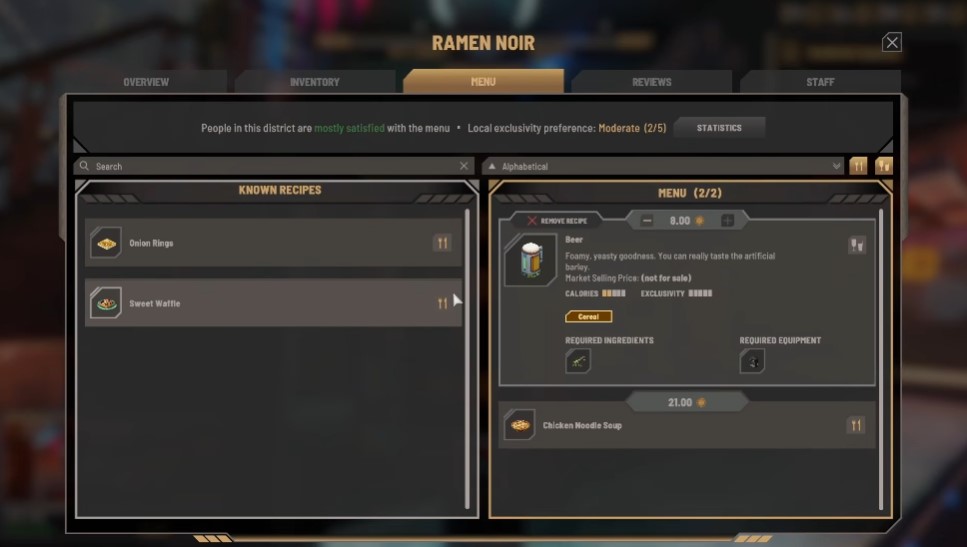
On Noodle Soup pricing — you can raise the menu price on the tablet by the entrance. If every seat fills during every rush that day, bump the price by +1. Keep doing that daily until empty seats start showing up, then drop it by -1. Hold a 4–5 star rating and you can creep well above the default price over time.
If nobody is scheduled for the 08:00–09:00 hours, the shop won’t open until 09:00. I like that — it gives me a window to restock accurately before the chaos starts.
Consider closing early. If no one is on shift from 23:00 the shop closes, handing you a free hour to gather leftover stock and sell it back to the merchants for cash. Handled this way, you can nearly negate all your food spoilage losses.
Clean out spoiled ingredients the moment you spot them — spoilage tends to infect neighboring ingredients. Even at a sell price of 0 lims to a vendor, get it out of the cabinet.
On Managers: they’re fine, and I expect future patches will improve them. The reason I avoid them early is that they’ll drain your bank account constantly buying stock, then get paid to stand around for 90% of their shift. Restocking yourself is the better play until you’ve built up wealth or you’re simply bored of managing the supply. I’d consider hiring one once you’re past 1000 lims — and remember you need to keep a float of around 1000 lims so the manager can always afford ingredients when they need them.
As much as I dismiss tables and chairs, you can expand into them eventually — just know it demands many extra waiter staff to function, and that wage bill offsets the profit from the added seating. Max out your stools first, then experiment with the tables.
Good luck with it, and have fun.