
After finishing Canada and putting real time into the three vehicles that ship with the demo, I wanted a way to answer one question honestly: which trucks are actually worth my upgrade money? The in-game stat screens don’t tell you how a vehicle stacks up against the rest of the roster, so I put together this comparison using the community’s unofficial OverTheHillDB database as my stat source. The raw numbers alone don’t mean much — what matters is how they sit relative to everything else you can drive, which is exactly what this guide is built to show.
A quick note on how I read these numbers: since upgrades push every vehicle upward, judging anything by its stock performance is misleading. I’m comparing vehicles against each other, not against some ideal. The Protector serves as my baseline reference point for the scoring.
How I Score Each Vehicle
Six criteria matter, and each stat lands in one of four brackets. The thresholds below are what I used to sort every vehicle into Strong, Average, Weak, or Warning territory.
Forward Grip: ≥1.30 is Strong, 1.10–1.29 Average, 1.00–1.09 Weak, below 1.00 is a Warning.
Slide Resistance: ≥1.27 Strong, 1.24–1.26 Average, 1.16–1.23 Weak, under 1.16 Warning.
Suspension Travel: ≥60 cm Strong, 55–59 cm Average, 45–54 cm Weak, below 45 cm Warning.
Steering Angle: ≥38° Strong, 28–37° Average, 24–27° Weak, under 24° Warning.
Wheel Radius: ≥0.46 m Strong, 0.40–0.45 m Average, 0.38–0.39 m Weak, below 0.38 m Warning.
Stage 3 Torque per Tonne: ≥75 Nm/t Strong, 70–74.9 Average, 65–69.9 Weak, under 65 Warning.
For that last one, the math is Stage 3 Engine Torque in Newton-metres divided by the vehicle’s mass in tonnes. It’s the closest thing to a real power-to-weight readout you can get from the data.
Two honest caveats before you take any of this as gospel. Some handling characteristics simply aren’t documented anywhere, including rollover risk (centre of gravity), ground clearance, wheelbase and track width, and turning radius. If a truck feels tipsy or scrapes on climbs despite good scores here, those missing figures are usually why.
Trail Class Comparison
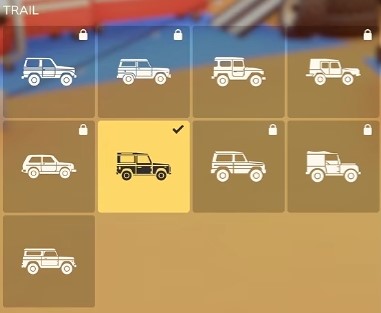
This is where the starter vehicles live, and the spread is narrower than you’d expect. The Protector, Brick, Bull v1, Tinny, Trailrat, Wombat, and Ding all sit at Average for Forward Grip and Slide Resistance, and every single one of them is Strong on Steering Angle. The real differentiators come down to suspension and wheels.
The Wombat edges out the Protector on wheel size — 0.43 m against 0.40 m — which puts it just ahead in that column. The Ding is the odd one out: Average suspension travel but Weak wheels, which is the first genuine red flag in this class. Lynx matches the Ding’s suspension picture with Average travel, while Polyana takes the roughest treatment of the group with Weak suspension travel and Warning-tier wheels. If you’re picking a Trail-class rig for bumpy ground, Polyana is the one I’d think twice about.
Torque per tonne is Average across the whole class, so nobody here has a meaningful power advantage. The takeaway: in Trail class, buy for wheels and suspension, not for speed.
Wagon Class Comparison
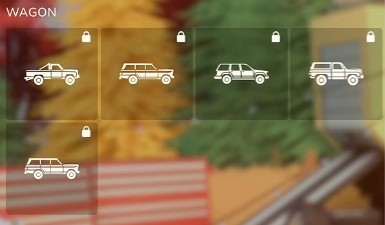
Wagons are defined by one glaring shared weakness: every single one of them — Trail Burner, Cumbre, Roamer, Woodman, and Grand Woodman — lands at Weak for suspension travel. That’s the cost of the class, and you should plan your routes accordingly.
On the plus side, Forward Grip, Slide Resistance, and Steering Angle are uniformly Average, and Stage 3 Torque per Tonne is Strong for the entire lineup. These things pull hard. The Trail Burner and Cumbre share the largest wheels in the class at 0.44 m, while the Woodman and Grand Woodman drop to Weak wheels. Between the two, the Grand Woodman is the heavier counterpart and the one I’d only reach for if the extra body is genuinely needed — the wheel penalty applies to both.
Workhorse Class Comparison
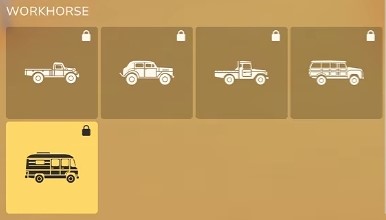
This is the most interesting class because the vehicles actually diverge. The Blast Wagon and Boar both score Strong on Forward Grip, Slide Resistance, and Wheel Radius — that’s a genuinely capable trio of traits, and the Blast Wagon backs it up with the biggest wheels in the group at 0.48 m.
Then there’s the Rust Ox, which goes its own way entirely. It has Strong suspension travel, the best in the class by a wide margin, but Warning-tier Forward Grip and Slide Resistance plus the smallest wheels on the roster at just 0.36 m. It’s a specialist: fantastic over rough terrain, slippery and twitchy everywhere else. The Burro and Timberbox sit in the middle with Average everything except Weak suspension travel.
Torque per tonne is Average across all five, so no Workhorse out-pulls its siblings. Pick the Blast Wagon or Boar for general use, the Rust Ox for technical climbs, and skip the rest unless you need the specific chassis.
Expedition Class Comparison
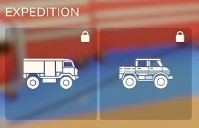
No ambiguity here. The Mammoth and Marshal are Strong on every single criterion — Forward Grip, Slide Resistance, Suspension Travel, Wheel Radius, and Stage 3 Torque per Tonne — with only Steering Angle sitting at Average. These are the endgame machines, and the data makes that plain. If you can unlock one, the rest of the roster stops mattering.
Vehicle Unlock Locations
Here’s every vehicle and where I found it, broken out by class. Each entry lists the map, then the specific trail or ascent you need to clear.
Trail Class
Protector — starting vehicle.
Brick — Gimli Ridge, unlocked via the Bridal Veil Falls Climb.
Bull v1 — Asgard Mountain, unlocked via the Blanshard Ridge Trail.
Tinny — Aurès Mountains, unlocked via the Ukhtayn Route.
Trailrat — starting vehicle.
Wombat — Tassili n’Ajjer Desert, unlocked via the El Kalaa North Ascent.
Ding — starting vehicle.
Lynx — Aurès Mountains, unlocked via the Mahrouqa West Track.
Polyana — Gimli Ridge, unlocked via the Elvis Rim Trail.
Wagon Class
Trail Burner — Emerald Lake, unlocked via the Windy Joe Trail.
Cumbre — Aurès Mountains, unlocked via the Jazira Ascent.
Roamer — Aurès Mountains, unlocked via the Kalaa Ulya Track.
Woodman — Tassili n’Ajjer Desert, unlocked via the El Kalaa South Ascent.
Grand Woodman — Asgard Mountain, unlocked via the Asulkan Lake Highline.
Workhorse Class
Burro — Emerald Lake, unlocked via the Hermit Trail.
Timberbox — Asgard Mountain, unlocked via the Midgar Ascent.
Blast Wagon — Gimli Ridge, unlocked via the Windcall Gorge Trail.
Boar — Tassili n’Ajjer Desert, unlocked via the Tarfa Ascent.
Rust Ox — Gimli Ridge, unlocked via the Waddington Scree Trail.
Expedition Class
Mammoth — Asgard Mountain, unlocked via the Lower Midgar Trail.
Marshal — Tassili n’Ajjer Desert, unlocked via the Shabah Ascent.
Which Vehicle Should You Upgrade?
If you want the short version: the Expedition pair is the obvious endgame target, and the Blast Wagon is the best general-purpose choice outside that tier thanks to its grip, slide resistance, and oversized wheels. Avoid pouring upgrades into the Polyana or Rust Ox unless you specifically need what they do — the Warning-tier stats on those two will follow you no matter how much you spend.
And one last thing worth repeating: handling you can feel isn’t fully captured by these numbers. Centre of gravity, clearance, wheelbase, and turning radius are all absent from the public data, so treat this comparison as a strong starting point, not a verdict. Take a vehicle out on a trail you know well before you commit.